
Public Art: Detroit’s Outdoor Gallery
Nine stops, two Marshall Fredericks bronzes, and the alley, the market and the block that turned Detroit into an open-air gallery.
- Stops 9
- Time Half a day, give or take
- Cost Free guide
- Best by Car (the first four stops are walkable)
The guide is free. Admission, food, drinks and parking along the way are on you.
Everything on this route is outdoors and free to look at, except the rooms inside the bead museum. The first four stops are a short walk from each other downtown; after that you’ll want wheels. Two stops, the Aretha Franklin mural and the Flying Geese at Elmwood, are ones we haven’t made it to yet. They’re marked, and we’d love your help with them.
The route in Google Maps, in parts
Stop 1
Monument to Joe Louis (“The Fist”)
ArtistRobert Graham, 1986VisitingOpen to visit
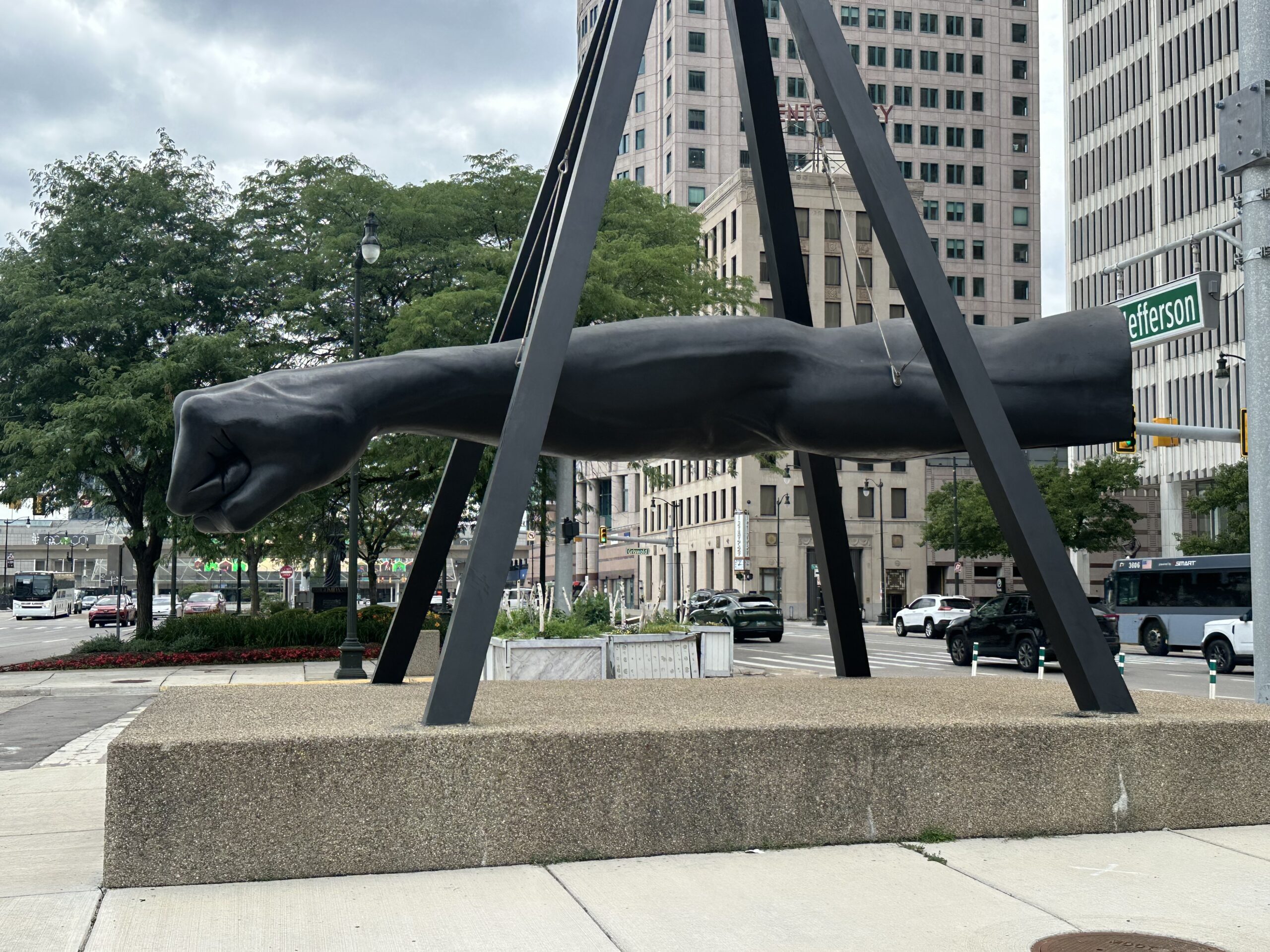
Start where Woodward runs out of road. The bronze arm hangs from a pyramid frame at Jefferson, in front of Hart Plaza: a 24-foot fist aimed at nothing in particular and everything at once.
Robert Graham made it as a tribute to Joe Louis, the Brown Bomber, who grew up on Detroit’s east side, learned to box at the Brewster recreation center and held the heavyweight title for nearly twelve years. It was dedicated in 1986, and people have argued about what it means ever since: a punch, a protest, a monument to the city’s toughness. Graham never settled it, which is part of why it works.
Stand under it, then look across Woodward. The next stop is in view.
Full listing: Monument to Joe Louis (“The Fist”)Get directions
Stop 2
The Spirit of Detroit
ArtistMarshall Fredericks, 1958VisitingOpen to visit
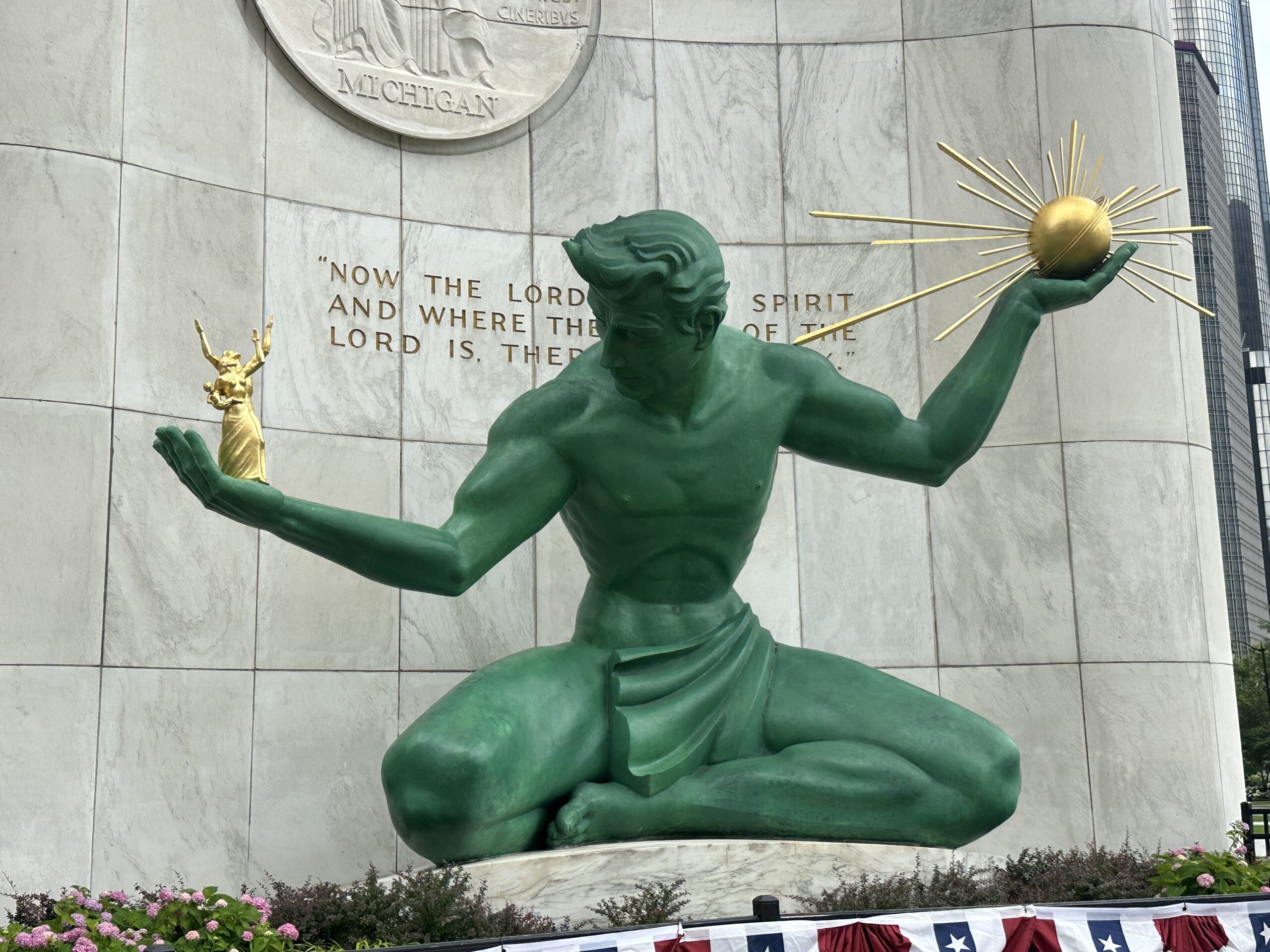
The city’s unofficial mascot sits in front of the Coleman A. Young Municipal Center. Marshall Fredericks’ seated figure is 26 feet of green bronze, with a gilded sphere in its left hand, meant to stand for God, and a small family in its right. The wall behind it quotes Second Corinthians: “Now the Lord is that Spirit: and where the Spirit of the Lord is, there is liberty.”
Detroiters treat it like family. When a team makes a run, the Spirit gets a jersey, and the Red Wings, Tigers, Lions and Pistons have all dressed it at one time or another.
Remember Fredericks’ name. His work turns up again at stop seven, in a very different setting.
Stop 3
The Belt
ArtistCurated by Library Street CollectiveVisitingOpen to visit
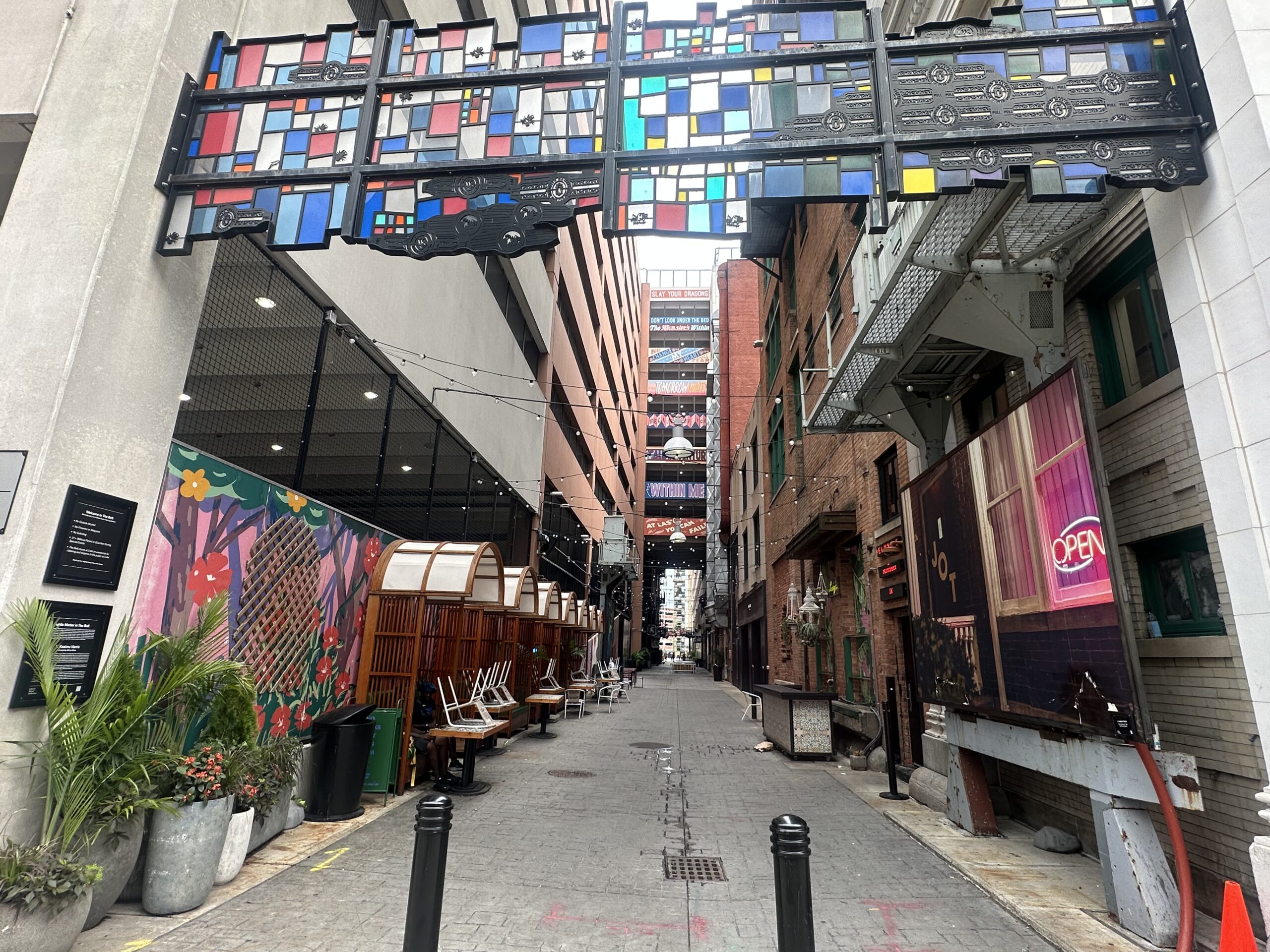
A short walk north, off Broadway, is the alley that rewired downtown’s art scene. The Belt runs between Broadway and Library Street, linking Gratiot and Grand River, and takes its name from the old garment district it cuts through.
Library Street Collective, the gallery that conceived it, turned it into an outdoor museum. The walls carry work by Shepard Fairey, FAILE, Cleon Peterson, Nina Chanel Abney and a long list of local and international artists, and a program called Public Matter rotates large paintings through, so it’s rarely the same alley twice.
It’s a hangout as much as a gallery, with bars opening onto it. If you can, come back after dark.
Stop 4
The Stevie Wonder Mural
ArtistRichard Wilson, 2019VisitingOpen to visit
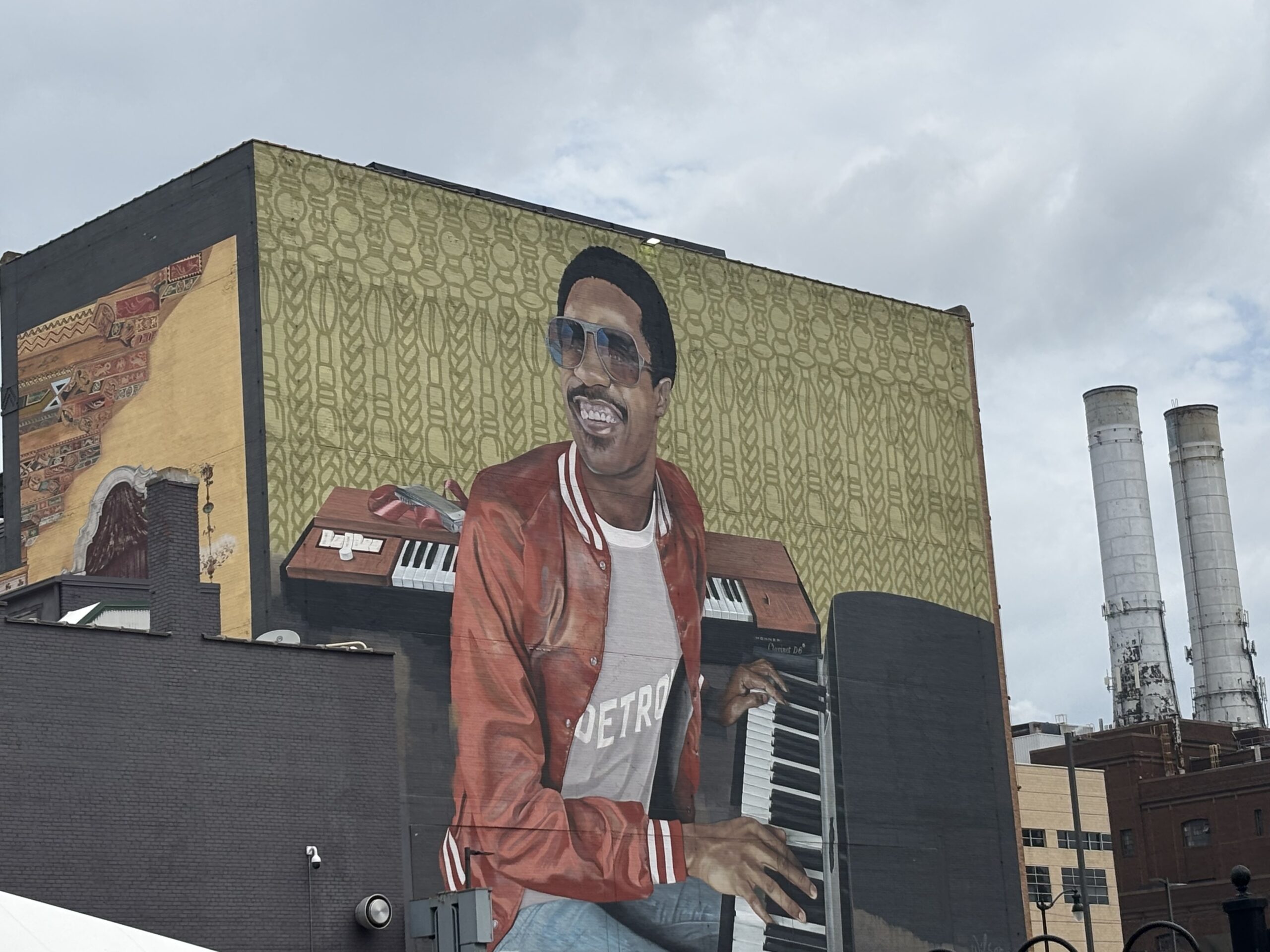
A few blocks east, on the south wall of the Music Hall Center for the Performing Arts on Madison Street, Stevie Wonder is about 100 feet tall. London artist Richard Wilson started painting him on Stevie’s 69th birthday in May 2019, fought a rainy spring and summer, and finished in July, in time for Motown’s 60th anniversary. The whole thing covers about 8,000 square feet.
Wilson painted a second mural on the building’s west wall, a boy inside the theater, as a call for arts education in Black communities. Walk around the corner for it.
Stevie grew up on the east side and signed to Motown at 11. If you’re doing our Motown route too, his childhood home is on it.
Recommended listening
“Signed, Sealed, Delivered I’m Yours” — Stevie Wonder, 1970
The first hit he produced himself. Queue it up for the walk over.
Stop 5
The Aretha Franklin Mural (Eastern Market)
ArtistRichard Wilson, 2018VisitingOpen to visitOur visitNot yet
Same artist, a year earlier. For Murals in the Market in 2018, Richard Wilson spent about twelve days on the back of Gratiot Central Market painting a run of classic Detroit album covers, Aretha Franklin’s among them, with J Dilla’s too.
The morning after he finished, he came back for touch-ups and found black paint dumped across the wall, most of it over Aretha. He spent the next day repairing it before flying home to London.
Eastern Market is worth slowing down for here. Saturday is the big market day, and the streets around the sheds are full of murals from years of Murals in the Market.
Recommended listening
“Think” — Aretha Franklin, 1968
Detroit’s own, on Atlantic, never Motown.
Full listing: The Aretha Franklin Mural (Eastern Market)Get directions
Stop 6
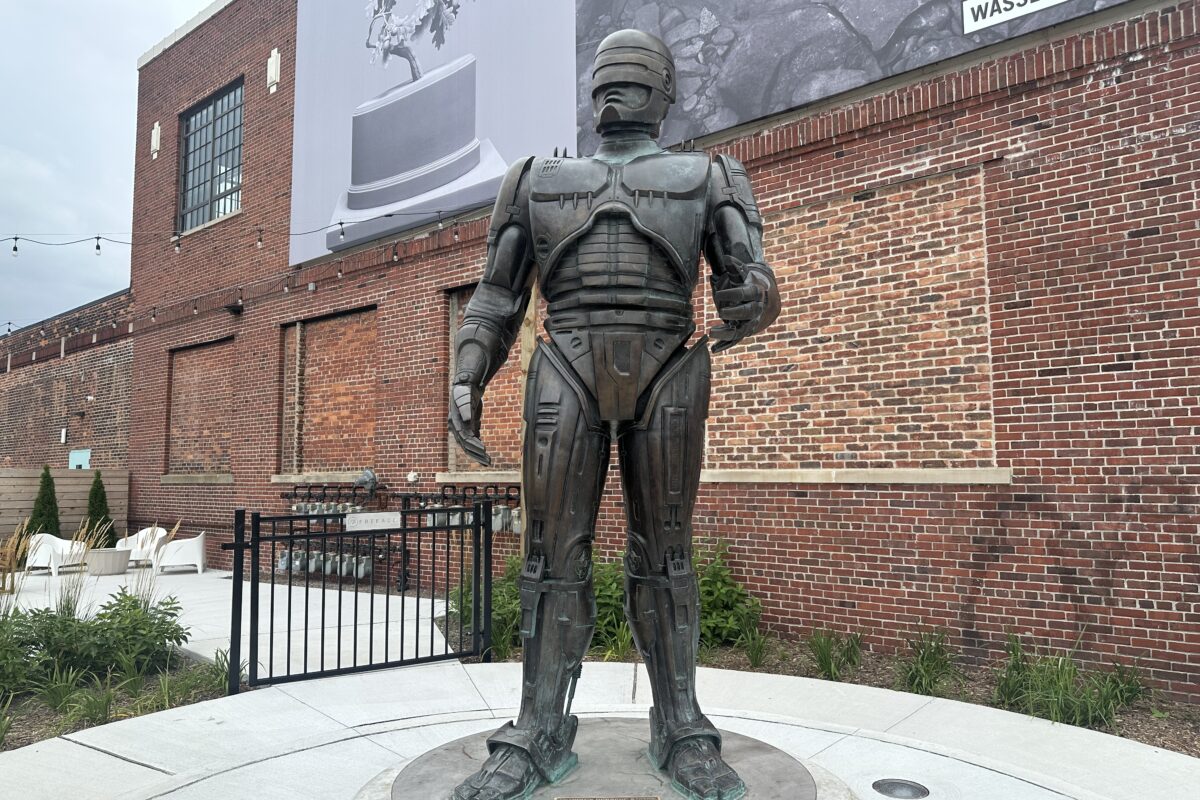
The RoboCop Statue
ArtistVenus Bronze Works, 2025VisitingOpen to visit
Detroit waited fourteen years for this one. In 2011, after a viral exchange about the city needing a RoboCop statue, a Kickstarter asked for $50,000 and raised $67,436 from 2,718 people in six days. Then came the hard part. Venus Bronze Works, led by conservator Giorgio Gikas, built it from molds of the original movie armor, and it spent years in limbo over sites, money and rights.
It finally went up on December 3, 2025, at 3434 Russell Street, just south of Mack in Eastern Market: 11 feet of bronze on a stainless steel base. He isn’t carrying his gun. His left hand is held out instead, which is a more Detroit gesture than anyone expected.
Take the selfie. Everyone does.
Stop 7
“Flying Geese” by Marshall Fredericks
ArtistMarshall FredericksVisitingCemetery groundsOur visitNot yet
Remember Marshall Fredericks from stop two? This is the quieter side of him. In Elmwood Cemetery, his “Flying Wild Geese” rises from the memorial to Alvan Macauley, the longtime president of Packard: a skein of bronze geese lifting off together, the opposite of the Spirit’s seated stillness.
Elmwood is worth the stop on its own. It dates to 1846, and Bloody Run Creek, where British troops and Pontiac’s warriors fought in 1763, once ran through the grounds.
It’s an active cemetery. Keep to the paths, keep it quiet, and check the gate hours before you go.
Full listing: “Flying Geese” by Marshall FredericksGet directions
Stop 8
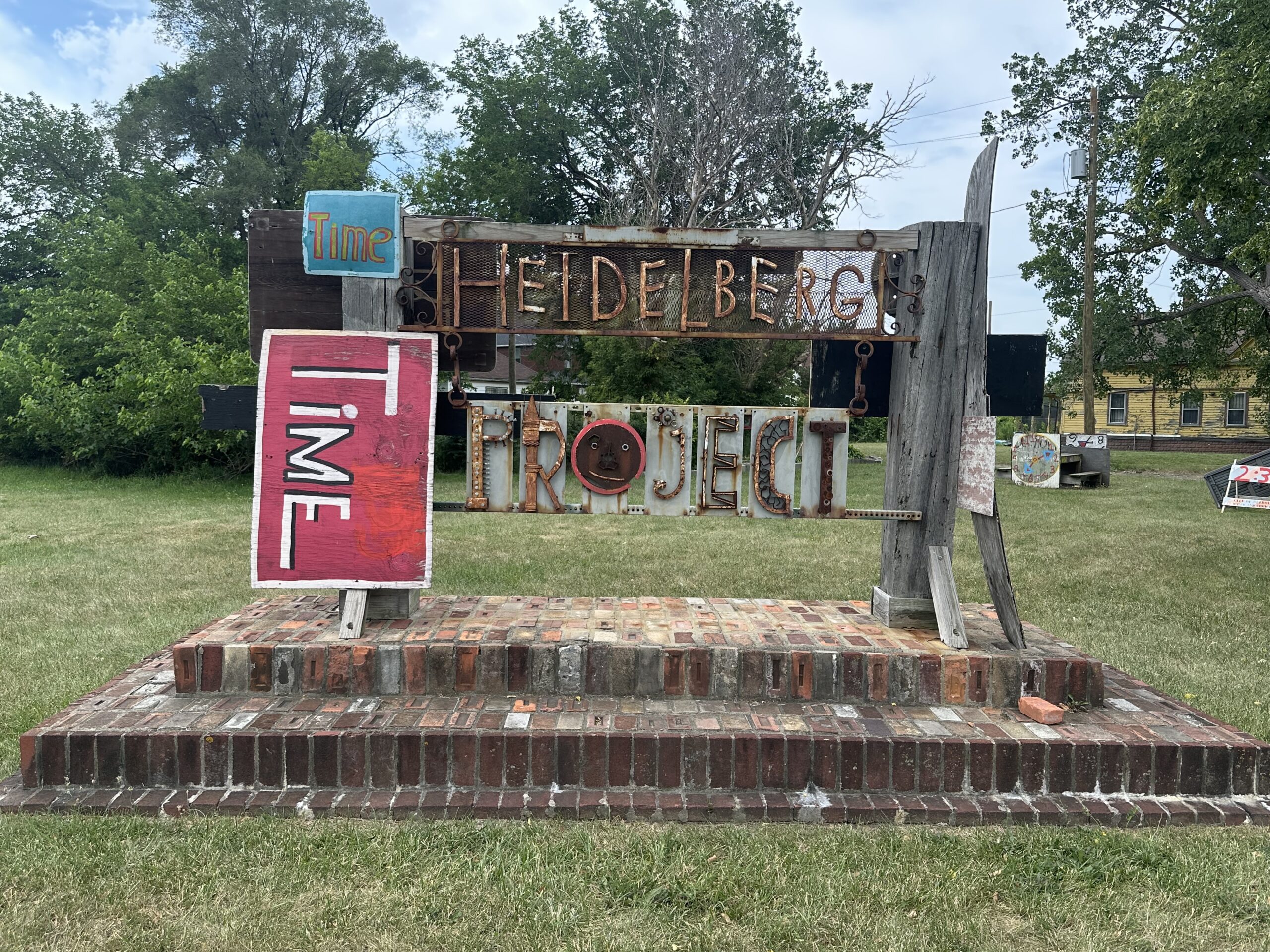
The Heidelberg Project
ArtistTyree Guyton, since 1986VisitingOpen to visit
Tyree Guyton started covering the houses on his childhood street in 1986: polka dots, stuffed animals, shoes, clocks, cars, whatever the neighborhood threw away. The city bulldozed parts of it twice, a string of arsons burned several houses in 2013 and 2014, and visitors kept coming anyway, from more than 140 countries by the guest book’s count.
Since 2016 Guyton has been taking much of it down on purpose, sending pieces to museums and galleries and turning the street into what the organization calls Heidelberg 3.0, an arts-centered neighborhood. What you find depends on when you come. That’s the point.
It’s on Heidelberg Street in McDougall-Hunt, on the east side. People live here: park, walk, look, and keep your voice down.
Stop 9
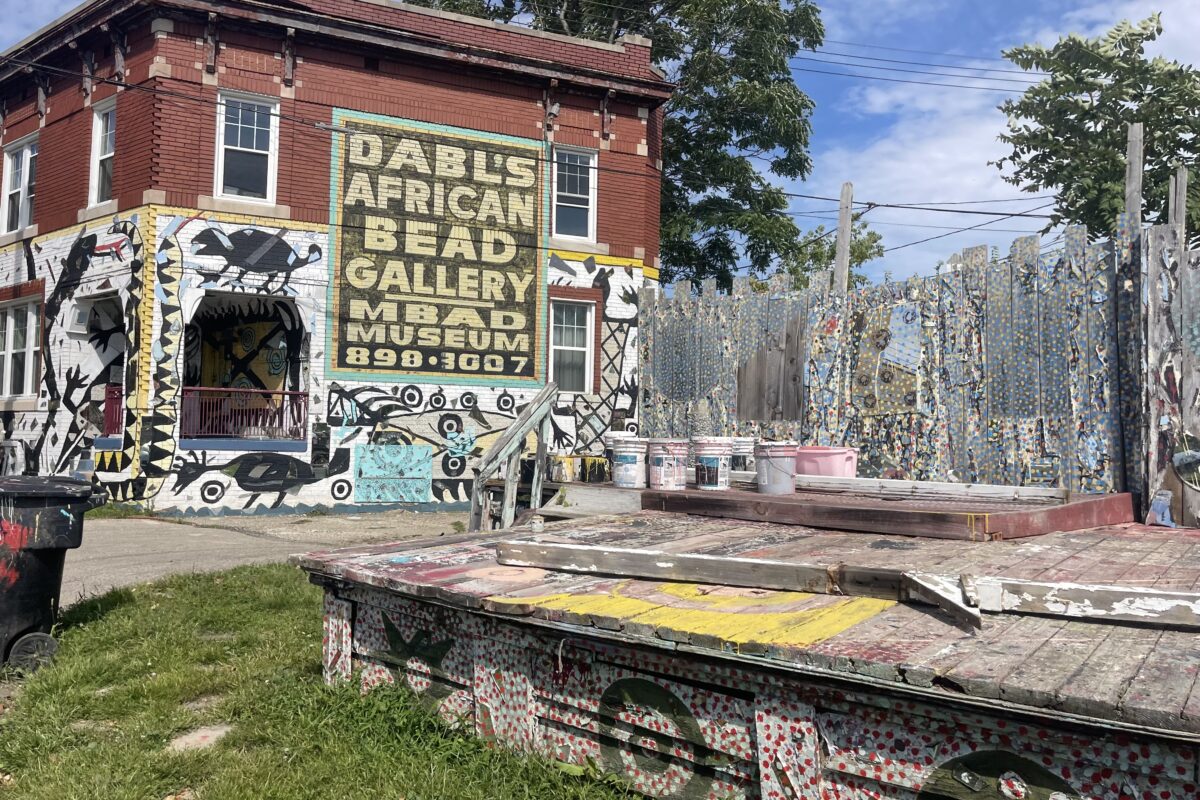
Dabls MBAD African Bead Museum
ArtistOlayami Dabls, since 1994VisitingOpen to visit
Finish across town on Grand River. Olayami Dabls started the African bead gallery that became MBAD in 1994, settled at this corner of Grand River and West Grand Boulevard in 1998, and has spent the years since turning the lot around it into one continuous artwork: broken mirror, painted wood, iron and stone across the outside walls and the lot next door, arranged to tell stories about African history and the materials themselves.
Inside, four rooms hold the collection: trade beads, many of them centuries old, plus sculpture, textiles and pottery. If Dabls is in, ask him about a piece. He’s the best guide there is.
Hours have run noon to 7, Monday through Saturday. Check before you cross town.