
Sports History: Detroit’s Lost Stadiums and the Ones Still Standing
Nine stops, from the three downtown venues to the ballpark and the barn that came before them and the two buildings that made Detroit a fight town, plus the dome and the palace as optional extensions.
- Stops 9 + 2 optional
- Time A full day, or two half days
- Cost Free guide
- Best by Car (the first four stops are walkable)
The guide is free. Admission, food, drinks and parking along the way are on you.
The first four stops are a short walk apart downtown; after that you’ll want a car, and the two optional extensions are out in Oakland County. Five stops are demolished, so you’re visiting sites, not buildings, and two are working facilities: Kronk is an active gym and the Silverdome site is an Amazon warehouse. We’ve been to one of these eleven stops, Little Caesars Arena. The other ten are marked, and we’d love your help with them.
The route in Google Maps, in parts
Stop 1
Comerica Park
Years in playOpened April 11, 2000VisitingTicketedOur visitNot yet
Start where Detroit plays baseball now, at Woodward and Montcalm. The Tigers opened Comerica Park on April 11, 2000, beating Seattle 5–2 on a cold, snowy afternoon in front of 39,168 people.
Walk the outside first. A 15-foot tiger guards the main gate, and 33 tiger heads with baseballs in their mouths line the brick walls. Inside, there’s a carousel behind the first-base stands and a Ferris wheel with baseball-shaped cars behind third, and two tigers prowl the left-field scoreboard, eyes lighting up after a Tigers home run or win. Out past left-center stand statues of the franchise’s greats, Ty Cobb, Al Kaline and Willie Horton among them, and Ernie Harwell’s statue waits just inside the gate.
This is also where Armando Galarraga lost his perfect game on a blown call in 2010 and Miguel Cabrera got his 3,000th hit in 2022.
Enjoy the name while it lasts: it becomes Fifth Third Park before the 2027 season.
Stop 2
Ford Field
Years in playOpened August 24, 2002VisitingTicketedOur visitNot yet
Ford Field is across Brush Street, close enough that on a game day the two crowds mix. The Lions moved downtown from Pontiac in 2002, and the stadium opened on August 24 that year.
Look at the long brick building wrapped into the south side. That’s a 1920s J.L. Hudson’s warehouse, kept and folded into the stadium instead of torn down. Most of the suites and club lounges are inside it, and the rest is offices. It’s the reason Ford Field looks like part of the city instead of something that landed on it.
The building has had a big run for a place where the home team didn’t win a playoff game until January 2024. It hosted Super Bowl XL in February 2006 and the Final Four in 2009, and it gets the Final Four again in April 2027. In April 2024, the NFL Draft took over the streets around it and the league counted about 775,000 people over three days, a record.
Stop 3
Little Caesars Arena
Years in playOpened September 5, 2017VisitingTicketed
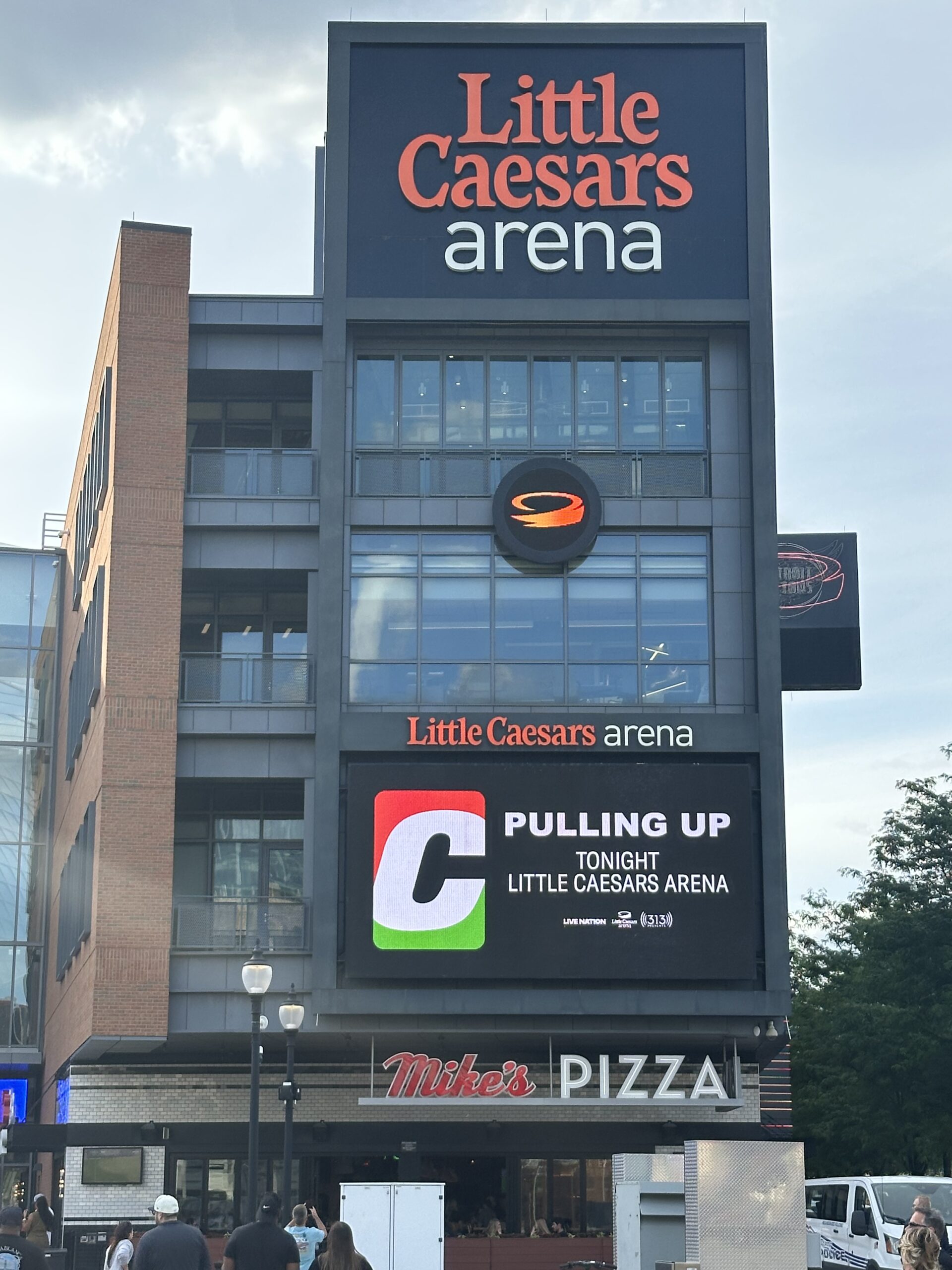
Walk north up Woodward to Little Caesars Arena, home of the Red Wings and the Pistons since 2017. It opened that September, and the bowl sits 40 feet below street level, so from the sidewalk it looks smaller than it is. Shops and restaurants are built into the buildings around it, linked by a glass-roofed concourse that works like an indoor street.
The arena brought the Pistons back downtown for the first time since they left Cobo Arena in 1978. In between came two suburban homes you’ll visit at the end of this route.
Inside, look for the original OLYMPIA letters, salvaged from the old Red Barn and mounted on an interior wall next to a Gordie Howe mural. They’re the thread that ties this stop to stop seven.
And before you go in, know that the big entertainment district promised around the arena has mostly not shown up yet. There are still a lot of parking lots.
Stop 4
Brewster-Wheeler Recreation Center
Years in playOpened 1929; Kronk inside since December 10, 2025VisitingExterior onlyOur visitNot yet
Cross under I-75 on Wilkins Street, a short walk east of the arena, to the building where Detroit boxing started. Brewster-Wheeler opened in 1929 as a city recreation center, and a teenage Joe Louis learned to fight in its basement. Sugar Ray Robinson tagged along as a kid, and a young Emanuel Steward started boxing here decades later.
The city closed it in 2006, and it sat empty for years while plans for a restaurant and community center came and went. Then, on December 10, 2025, Kronk Gym reopened inside it, with Steward’s widow, Marie, and daughter Sylvia Steward-Williams involved, and Hilmer Kenty, Kronk’s first world champion, part of the team. In April 2026, former Red Wing Darren McCarty announced a pro wrestling school in the building too.
It’s a working gym, not a museum. Look from Wilkins, or check with the gym before you walk in. The larger redevelopment is still a work in progress.
Full listing: Brewster-Wheeler Recreation CenterGet directions
Stop 5
Joe Louis Arena (“The Joe”)
Years in playDecember 1979 to 2017, demolished 2019–2020VisitingDemolished — site onlyOur visitNot yet
Now get in the car and head for the river. Joe Louis Arena stood at the foot of the Lodge Freeway from December 1979 until 2017, a plain concrete box that a generation of Red Wings fans loved anyway.
The Wings won four Stanley Cups in the Joe years and clinched two of them on home ice, in 1997 and 2002. The octopus kept flying, a habit carried over from Olympia, and the noise in the building when it was full was the stuff of legend. The last Red Wings game was April 9, 2017, a 4–1 win over New Jersey.
Demolition started in 2019 and wrapped up in 2020. The site is now Water Square: a 25-story apartment tower opened in 2024, and a JW Marriott hotel is due in 2027, with Second Avenue being stretched south to meet Steve Yzerman Drive.
There’s nothing of the arena left. Look for the street name.
Stop 6
Tiger Stadium / The Corner
Years in playBaseball here 1896 to 1999VisitingSidewalk onlyOur visitNot yet
Head west to Corktown, to Michigan and Trumbull. People played professional baseball on this corner from 1896, first at Bennett Park and then, from April 20, 1912, at Navin Field, which became Briggs Stadium and finally Tiger Stadium. The Tigers played their last game here on September 27, 1999. After a long fight to save it, the stadium was gone by 2009.
The field never left. Volunteers mowed it for years, and in 2018 the Detroit Police Athletic League opened The Corner Ballpark on the old diamond, with PAL’s headquarters along left field and apartments and shops along the edges. The field’s full name is Willie Horton Field of Dreams.
Look for the flagpole. The 125-foot pole in deep center field is the original from Tiger Stadium, still standing in fair territory where it always was.
It’s a youth sports facility, so watch from the sidewalk unless there’s a game or event on.
Stop 7
Olympia Stadium (“The Old Red Barn”)
Years in play1927 to 1979, demolished 1986VisitingDemolished — site onlyOur visitNot yet
Drive northwest up Grand River to McGraw. Olympia opened here in 1927, designed by C. Howard Crane, and for 52 years it was the Old Red Barn, home of the Red Wings through Gordie Howe, Ted Lindsay and Sid Abel and the Cups of the early ’50s.
It was more than a hockey rink. Sugar Ray Robinson and Jake LaMotta fought here twice in 1943. The Beatles played in 1964 and 1966, and Elvis, the Rolling Stones and Led Zeppelin came through too. The octopus tradition started here in 1952, when two brothers who ran a fish market threw one on the ice, eight arms for the eight playoff wins it then took to win the Cup.
The Wings played their last game here on December 15, 1979, and the building came down in 1986. A Michigan National Guard armory stands on the site now, with a marker inside. Its letters, as you saw, went downtown.
Full listing: Olympia Stadium (“The Old Red Barn”)Get directions
Stop 8
The Original Kronk Gym
Years in playOpened 1921; closed 2006; demolished 2018VisitingDemolished — site onlyOur visitNot yet
A short drive southwest, at 5555 McGraw near Junction, is where one of the most famous boxing gyms in the world used to be. The Kronk Recreation Center opened in 1921, named for city councilman John Kronk, and the gym was in its basement.
Emanuel Steward made it world famous. Hilmer Kenty became Kronk’s first world champion in 1980, and Thomas “Hitman” Hearns followed months later. Milton McCrory, Jimmy Paul and Duane Thomas won titles too, and Steve McCrory took Olympic gold in 1984. The red and gold trunks became a brand.
The end was slow and sad. Thieves stripped the copper pipes in 2006 and the city closed it that November. A fire gutted the empty building in October 2017, and it was demolished in 2018. Nothing of the gym stands now.
The good news is at stop four: the name lives on, and it’s back in the building where Joe Louis learned to box.
Stop 9
Historic Hamtramck Stadium
Years in playOpened 1930; restored 2022VisitingOpen to visitOur visitNot yet
Drive east to Hamtramck and Veterans Memorial Park, off Dan Street. Hamtramck Stadium opened in May 1930, built by John Roesink, a Detroit clothier who owned the Negro National League’s Detroit Stars. It hosted the deciding games of the 1930 Negro National League championship series, and the Stars played here again in the 1930s. Josh Gibson and Satchel Paige were among at least 16 future Hall of Famers who played on this field.
It’s one of only a handful of Negro leagues ballparks still standing. The grandstand sat crumbling for decades until a preservation group, the Friends of Historic Hamtramck Stadium, pushed it onto the National Register in 2012 and raised money for a $2.6 million restoration. It was rededicated on June 20, 2022, as part of Juneteenth.
The field is named for Norman “Turkey” Stearnes, the Stars’ Hall of Fame outfielder. Youth and high school teams play here now. It’s a public park; walk up to the grandstand.
If you have more time
Optional extensions
These are worth the extra drive for the devoted. The main route works without them.
Extensions in Google Maps, from the last stop
Optional stop
The Pontiac Silverdome
Years in playOpened 1975; demolished 2017–2018VisitingDemolished — site onlyOur visitNot yet
Now the long drive north to Pontiac. The Silverdome opened in August 1975 under a fabric roof held up by air pressure, and it was the Lions’ home from 1975 through the 2001 season and the Pistons’ from 1978 to 1988.
Its list of big days is hard to beat. Super Bowl XVI was here on January 24, 1982. WrestleMania III drew a reported 93,173 on March 29, 1987, Hulk Hogan against André the Giant. Six months later, on September 18, 1987, Pope John Paul II said Mass for 93,682. And in June 1994, the U.S. played Switzerland here in the first World Cup game ever played indoors.
After the teams left, it sat empty and decayed. The first implosion on December 3, 2017, famously failed to bring it down; the second worked the next day. Amazon built a distribution center on the site. Drive by on Featherstone, but don’t pull into a working warehouse lot.
Optional stop
The Palace of Auburn Hills
Years in play1988 to 2017, demolished 2020VisitingDemolished — site onlyOur visitNot yet
Finish a few miles east in Auburn Hills. The Palace opened on August 13, 1988, just in time for the Bad Boys. The Pistons won back-to-back titles in 1989 and 1990, and in June 2004 they closed out the Lakers on this floor for their third. The Detroit Shock won three WNBA titles in the building, and its address, 6 Championship Drive, counted all of them.
It also hosted the worst night in NBA history. On November 19, 2004, a brawl between the Pistons and Pacers spilled into the stands, and the Malice at the Palace led to long suspensions.
The Pistons played their last game here on April 10, 2017, and moved downtown. The Palace was demolished in 2020, the roof brought down with explosives on July 11. The site is slated for an auto-parts plant tied to General Motors, but as of spring 2026 construction hadn’t started.
For now, it’s an empty site on Lapeer Road.