
Techno: From Belleville to Hart Plaza
Six stops, from the club that lasted eighteen months to the block that named a genre and the radio station that started it, plus an optional drive to the small town the founders came from.
- Stops 6 + 1 optional
- Time Half a day, plus a night out if you can
- Cost Free guide
- Best by Car (the first three stops are walkable)
The guide is free. Admission, food, drinks and parking along the way are on you.
Hart Plaza, the Music Institute and Techno Boulevard are a walk of about two miles downtown; the rest need a car, and Belleville is a half-hour drive west. Most of these buildings are private, so look from the sidewalk. Exhibit 3000 is by appointment only, and the WGPR museum keeps limited hours, so plan ahead. We’ve been to two of these seven stops, Hart Plaza and TV Lounge. The other five are marked.
The route in Google Maps, in parts
Stop 1
Hart Plaza
The connectionMovement festival, Memorial Day weekend most years since 2000VisitingOpen to visit
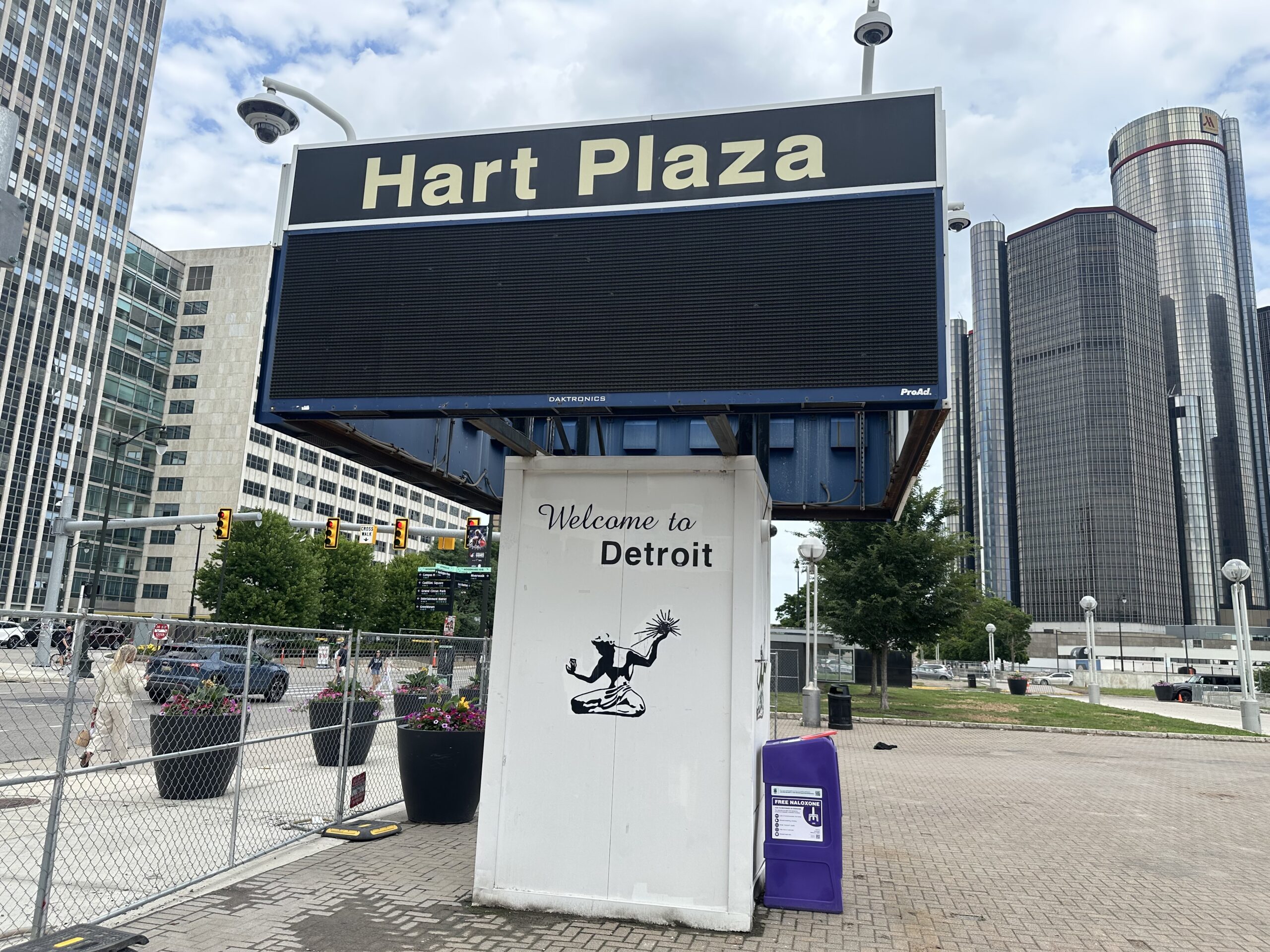
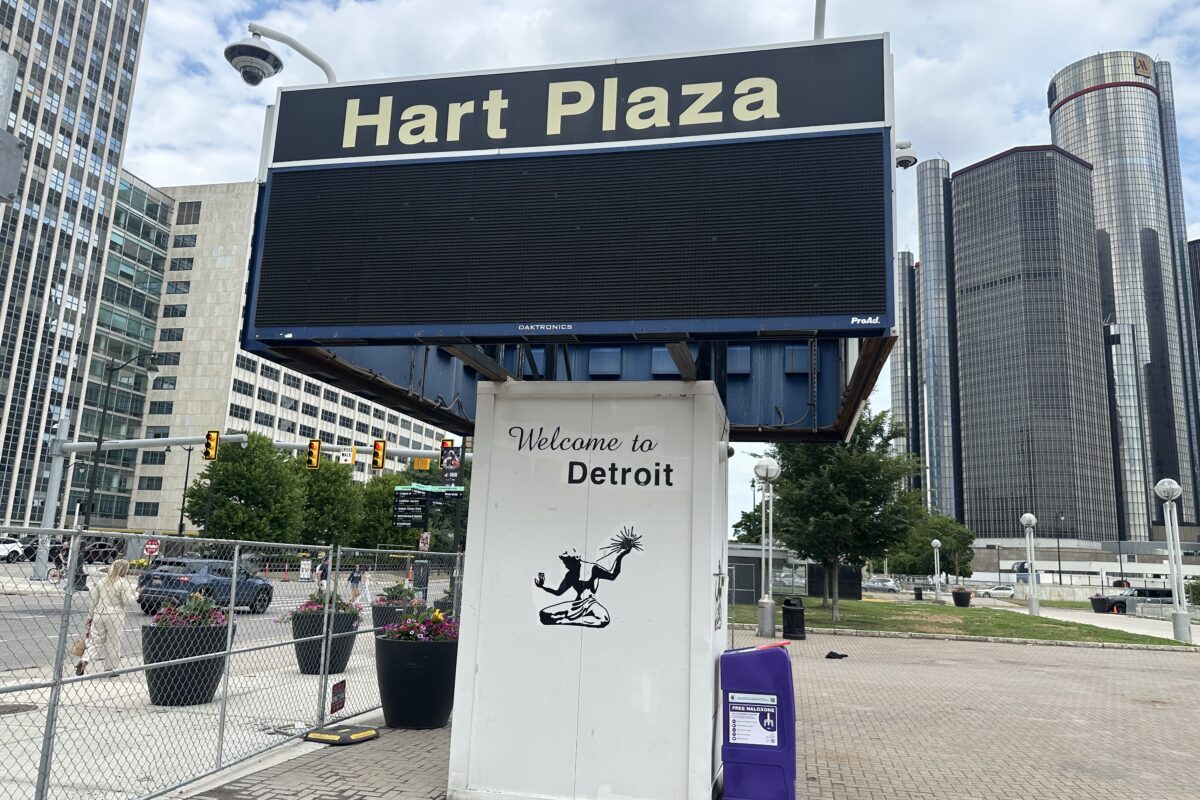
Start at the river, where techno comes home once a year. Hart Plaza sits at the foot of Woodward, a sunken concrete plaza built in the 1970s, with Isamu Noguchi’s Dodge Fountain, a steel ring on two legs, in the middle of it.
In May 2000, the city threw the first Detroit Electronic Music Festival here, free, with Carl Craig as artistic director. It was a coming-out party for music that had been bigger in Berlin and London than at home. The festival changed names and hands over the next few years, with Derrick May running it as Movement in 2003 and 2004 and Kevin Saunderson as Fuse-In in 2005. Paxahau has produced it as Movement since 2006, and it skipped 2020 and 2021 for the pandemic. It’s ticketed now, and it fills the plaza, including the stage down in the underground level.
The 2026 edition ran May 23–25. The rest of the year, it’s a quiet place to sit by the fountain and look at Windsor.
Recommended listening
“Good Life” — Inner City, 1988
Kevin Saunderson’s crossover hit, and still the sound of a Hart Plaza singalong.
Stop 2
The Music Institute
The connectionMay 1988 to November 1989VisitingSidewalk onlyOur visitNot yet
Walk north to 1315 Broadway. For about eighteen months, this four-story former shoe store was the Music Institute, the club where Detroit techno found its first real room.
George Baker, Chez Damier and Alton Miller opened it in May 1988, inspired by the house clubs in Chicago. There was no liquor, just a juice bar, and a membership system kept the crowd close. Derrick May played Fridays, with Darryl “D-Wynn” Wynn, and Miller and Damier took Saturdays, leaning toward vocal house and disco. The story goes that Depeche Mode showed up one night and couldn’t get a drink.
The money never worked, and the Institute closed in November 1989. On the last Friday, May finished with 808 State’s “Pacific State,” and people who were there say the room cried.
The building still stands. It’s private, so look from the sidewalk.
Recommended listening
“Pacific State” — 808 State, 1989
The last record played on the last Friday.
Stop 3
Techno Boulevard (Metroplex, Transmat & KMS)
The connectionMetroplex (1985), Transmat (1986), KMS (1987)VisitingSidewalk onlyOur visitNot yet
Keep going east toward Eastern Market, to the stretch of Gratiot around Russell and Riopelle that Derrick May wanted to call Techno Boulevard. In the late 1980s, the three labels that defined the music worked a few doors apart here: Juan Atkins’ Metroplex, May’s Transmat and Kevin Saunderson’s KMS. Carl Craig has said Metroplex was on the ground floor and Transmat upstairs in the same building, and that May was still living there decades later.
The records that came out of this block went around the world. Transmat released “Strings of Life” and “Nude Photo” under May’s Rhythim Is Rhythim name; KMS put out Inner City. In 1988, a British compilation called Techno! The New Dance Sound of Detroit gave the whole thing its name.
May’s story has a hard chapter too. In 2020, more than a dozen women accused him of sexual misconduct. He denied it, and festivals dropped him.
The buildings are private. Walk the block and keep to the sidewalk.
Recommended listening
“Strings of Life” — Rhythim Is Rhythim, 1987
The Transmat record that made a piano riff into an anthem.
Full listing: Techno Boulevard (Metroplex, Transmat & KMS)Get directions
Stop 4
WGPR & the William V. Banks Broadcast Museum
The connectionThe Electrifying Mojo, early 1980sVisitingOpen to visitOur visitNot yet
Drive east along Jefferson to number 3146. This is where Dr. William V. Banks put WGPR-TV on the air on September 29, 1975, the first television station in the country independently owned and operated by African Americans. Banks and the Masonic order he led had bought WGPR radio, 107.5 FM, in 1964.
For techno, the radio side is the story. In the early 1980s, Charles Johnson, the Electrifying Mojo, hosted The Midnight Funk Association on WGPR, five hours of late-night radio that put Kraftwerk next to Prince and Parliament. For Atkins, May and Saunderson, the show was the main source of the electronic and funk records that shaped them, and by 1981 Mojo was playing their own mixes.
The building is now the William V. Banks Broadcast Museum, opened in January 2017 and since added to the National Register of Historic Places. Check the museum’s Facebook page for hours before you go.
Recommended listening
“Numbers” — Kraftwerk, 1981
Düsseldorf by way of Mojo, the record Detroit took and ran with.
Full listing: WGPR & the William V. Banks Broadcast MuseumGet directions
Stop 5
Exhibit 3000 & Submerge
The connectionUnderground Resistance, since 1989VisitingAppointment requiredOur visitNot yet
Head north to East Grand Boulevard. The building at 3000 has no sign, and that’s on purpose. It’s home to Underground Resistance, the militant, faceless label Jeff Mills and “Mad” Mike Banks started in 1989, and Submerge, the distribution company that has carried Detroit records to the world.
Upstairs is Exhibit 3000, billed as the world’s first techno museum: photos and records from Atkins, May, Saunderson, Eddie Fowlkes and Cybotron, a room of synths and drum machines, material from DJ Ken Collier, and Ron Murphy’s 1939 mastering lathe. DJ John Collins has been giving the tours. It’s by appointment only, so set one up through Submerge before you go.
Downstairs, the Somewhere in Detroit record shop sells UR records and shirts, and visitors sign the walls. It has kept Saturday afternoon hours; check before you drive over.
Recommended listening
“Hi-Tech Jazz” — Galaxy 2 Galaxy, 1993
Mike Banks’ UR crew, proving techno could swing.
Stop 6
TV Lounge
The connectionTechno, house and ghettotech, and Movement afterpartiesVisitingRestaurant or bar
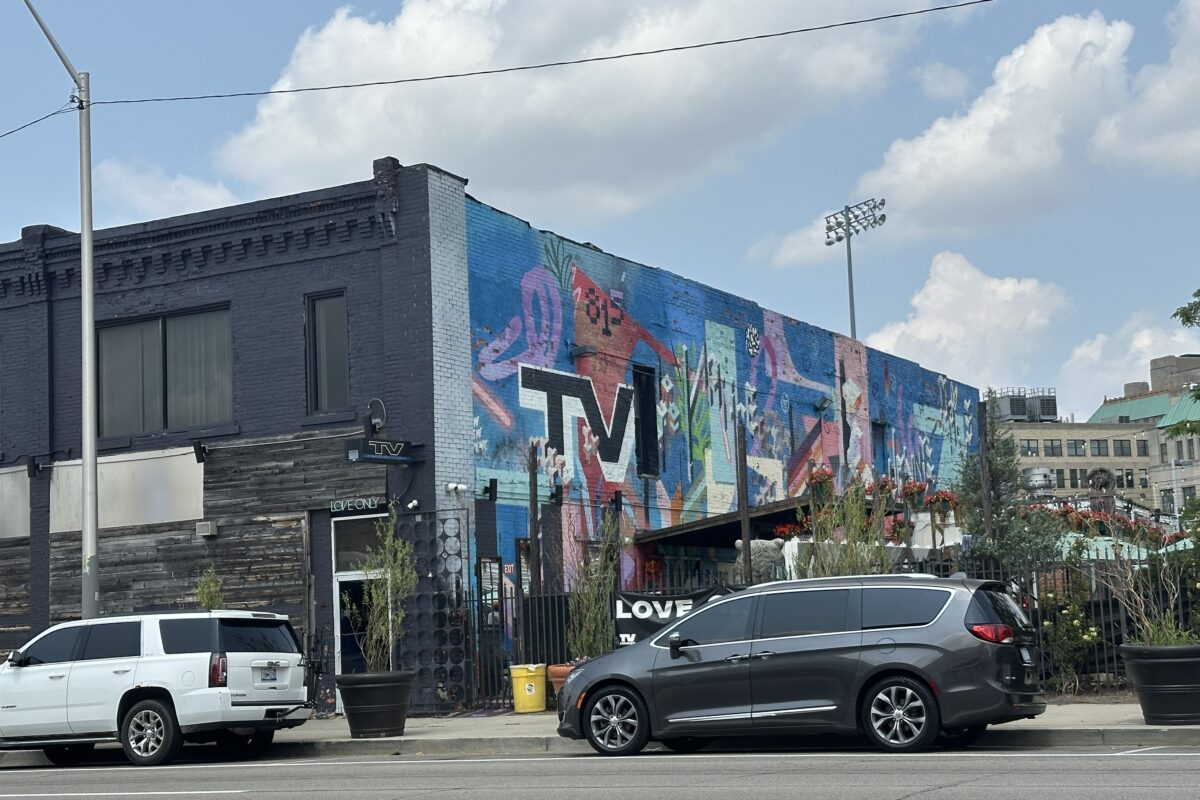
Come back toward downtown for the part of the story that’s still being written. TV Lounge sits on Grand River on the edge of the Cass Corridor, and it’s one of the rooms where Detroit’s dance music lives night to night: techno, house and ghettotech, local DJs and touring ones.
On Movement weekend it’s one of the busiest afterparty stops in the city, and the patio is the draw on a summer night. It’s a good bookend to Hart Plaza: the festival is one weekend a year, and rooms like this one are where the music lives the other fifty-one. If you only see the history on this route and never hear the music played loud to a crowd, you’ve missed the point.
Schedules change week to week and many nights are ticketed, so check the lineup before you go.
If you have more time
Optional extensions
These are worth the extra drive for the devoted. The main route works without them.
Extensions in Google Maps, from the last stop
Optional stop
Belleville (Birthplace of Techno)
The connectionJuan Atkins, Derrick May and Kevin SaundersonVisitingSidewalk onlyOur visitNot yet
Finish where it started, about half an hour west of downtown off I-94. Belleville is a small town on a lake, and it’s the reason the founders of techno are called the Belleville Three.
Juan Atkins and Derrick May were both born in Detroit and moved out here as kids. Kevin Saunderson came from Brooklyn at nine and met them at Belleville High School. Atkins was the one who started it: at Washtenaw Community College he met Rick Davis, and as Cybotron they released “Alleys of Your Mind” in 1981 on their own Deep Space label. It sold about 15,000 copies, mostly in Detroit. Atkins had been using the word “techno” since those Cybotron days.
As far as we can find, there’s no marker in town. The three of them only started performing as a group under the Belleville Three name in 2017. Drive past the high school, look at the lake, and think about how far this went from here.
Recommended listening
“Alleys of Your Mind” — Cybotron, 1981
Where it begins: Atkins and Davis, homemade and strange.
Full listing: Belleville (Birthplace of Techno)Get directions